Infercorp
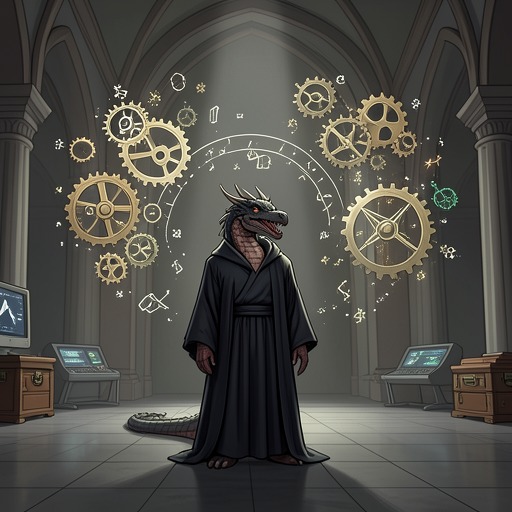
Vainqueur the DragonInfercorp is a Hell-based corporation whose defining power is the conversion of demonic brutality into ordinary corporate procedure. It presents itself as legitimate, safety-conscious, and commercially rational even while dealing in souls, executions, forced labor, and predatory contracts. Its involvement in Murmurin turns the organization from a distant infernal institution into a direct political and economic actor in the monster empire, making it one of the clearest embodiments of the setting’s fusion of supernatural power and business logic.
Nature and Corporate Structure
Infercorp is represented by Malfaisant, an ice demon classified as a bug demon and described as a local manager of one of Hell’s corporations. His identity establishes the organization’s characteristic contradiction: he is a major demon with the appetites and supernatural durability associated with his kind, yet he speaks in the language of shareholders, markets, partnerships, procedures, and operating costs. The corporation is not portrayed as a chaotic mob of fiends. It has managers, lawyers, soldiers, shareholders, construction projects, marketing departments, and formal protection programs, giving Hell the structure of a multinational company rather than a purely mythic realm.
Malfaisant’s later promotion makes the hierarchy more explicit. After the shareholders approved the Murmurin project, they promoted him to Vice-President of Mortal Market Development. He explains that his predecessor was “chocolatined,” a grotesque corporate euphemism that preserves the violence of demonic politics while disguising it as an internal business event. The promotion also shows that Infercorp evaluates infernal officials through expansion and profitability: success in the mortal market is rewarded with higher office.
The corporation’s institutional language repeatedly insists on legitimacy. Infercorp claims to be mindful of post-mortem customer safety, treats its dealings as contractual rather than openly predatory, and relies on paperwork when its interests are challenged. Its bureaucracy does not soften the underlying violence; it gives that violence a stable and exportable administrative form.
Business Model and Methods
Infercorp’s commercial imagination begins with the waste economy around Vainqueur Knightsbane’s domain. Victor Dalton is ordered to stop leaving monster parts, corpses, and other remains for animals to eat and instead find a way to make money from them. The proposed shop would sell junk, monster parts, and corpses, placing Infercorp within a broader economic movement that seeks to turn every leftover resource of monster life into merchandise. The organization’s later presence confirms that this is not merely Victor’s improvisation but part of a world in which demonic enterprise can supply the infrastructure for such markets.
Malfaisant’s first major proposal to Victor is even more revealing. He offers to reroute Infercorp’s summoning channel so that Murmurin receives victims of corporate downsizing and violent layoffs. These casualties would be processed as part of a severance arrangement: Infercorp reduces its execution costs, while Murmurin receives free labor. The transaction turns mortal economic failure into infernal supply. People discarded by corporations become inputs for another corporation, and the language of efficiency makes the arrangement appear like a mutually beneficial partnership.
This proposal also establishes Infercorp’s ability to operate across worlds and systems. It does not merely sell demonic objects in Hell; it manages channels between mortal and infernal economies, identifies usable labor, and repackages death as a cost-saving opportunity. The organization’s business model therefore depends on mediation: it stands between employers and the dead, between summoners and victims, and between mortal communities and infernal markets.
Alliance with Victor Dalton and Corporate Protection
Infercorp’s relationship with Victor Dalton begins as a business proposition. Malfaisant recognizes Victor’s interest in developing his region economically and offers opportunities including succubus brothels and casinos. Victor is not treated primarily as a warrior or adventurer but as a potential regional partner whose authority can open a new market. Murmurin becomes valuable precisely because Victor and Vainqueur Knightsbane are building a functioning monster polity there.
The partnership later acquires legal force when Victor is seized by Isabelle Maure’s forces. Malfaisant arrives with two suited bug associates, one apparently acting as a lawyer, and declares that Infercorp is protecting its client. A formal Faustian Associate Protection Program covers Victor because he is recognized as a true mortal partner of Infercorp on Outremonde. The corporation invokes a non-competition clause and warns that violence against Victor would constitute corporate warfare, potentially triggering the deployment of imp ninjas.
This intervention changes the balance of power around Victor. Infercorp’s protection does not come from affection or moral concern. It is an assertion of commercial ownership and market rights. Victor is valuable because he is an established partner and because competing powers must not seize or damage an Infercorp investment. Malfaisant uses that protection to request approval for the corporation’s construction project, demonstrating that legal defense and political leverage are inseparable from the company’s commercial expansion.
Malfaisant’s advancement also reflects the success of the alliance. The shareholders’ enthusiasm for the Murmurin project leads directly to his promotion, while the project grants Infercorp a foothold in the mortal world. Victor’s status as a protected client therefore has consequences beyond personal safety: it helps create an institutional shield around Murmurin’s economic development and makes the empire part of Infercorp’s growth strategy.
Nethermart and the Murmurin Project
Infercorp’s most visible achievement in Murmurin is Nethermart, a large six-floor building in the northern part of the city. Constructed by bug fiends under Malfaisant’s direction, the building is draped in ivory and becomes the tallest structure in Murmurin after Emperor Vainqueur’s statue. Its rounded architecture is described by the fiends as modern and trendy, marking a deliberate visual break from the surrounding environment and announcing the arrival of an imported commercial culture.
At the grand opening, Malfaisant presents Nethermart as the first fiendish magic-item shop in Outremonde open to monsters and mortals. Customers who cannot pay with coins may keep a tab by offering their souls as collateral. The store therefore extends Infercorp’s reach through consumer credit: the customer’s inability to pay does not exclude the customer but creates a more intimate and dangerous form of indebtedness. The coming war with Maure is incorporated into the launch campaign through a thirty-percent discount on weapons, linking retail promotion to military mobilization.
Nethermart’s success is measured through financial speculation as well as sales. Malfaisant reports that its share value is through the roof on Soulwell Street and attributes the rise to goodwill created by the current partnership. He expects the resulting momentum to produce profits on the soul stock exchange. The phrase captures Infercorp’s full logic: public approval, political alliance, retail access, and spiritual commodification all feed the same investment cycle.
The shop’s catalog is broad but not unlimited. It no longer sells swords because of the mysterious mass disappearance of swords in the region, showing that Infercorp responds to supply conditions and local crises rather than operating from a fixed inventory. It also refuses to sell love potions, defining them as unethical because they function like drugging someone and violate free will. This apparent principle is less a rejection of corporate logic than its refinement. Infercorp protects consent because consent is described as a cornerstone of its bottom line, presenting commercial self-interest as an ethical standard.
Rebranding, Legitimacy, and Significance
Infercorp’s most pointed act of institutional self-fashioning is its rebranding of Hell as Happyland. Malfaisant explains that decades of benchmarking studies led the Corporate Overlords to decide that the name Hell was no longer politically correct. The new name is designed to sound like a fair, and marketing considers that reaction successful. The corporation expects mortals to assimilate the branding within fifty years, with the change tied to increased soul revenue.
The rebranding reveals how Infercorp handles moral contradiction. It does not abolish infernal practices; it changes the vocabulary surrounding them. Soul revenue remains the goal, but the organization seeks to make the destination sound cheerful. Its insistence that Happyland does not sell mind-control devices further demonstrates the method: it defines itself against a particularly obvious abuse while leaving the broader machinery of soul commerce, contractual coercion, and institutional exploitation intact.
Infercorp consequently functions as both organization and satire of institutional legitimacy. Its demons use contracts, legal departments, shareholder approval, branding research, customer protection, and ethical product policies to make infernal predation appear orderly. The result is not a simple contrast between civilized business and monstrous Hell. Infercorp shows how monstrosity can become more expansive when it acquires offices, procedures, investment incentives, and a polished public identity. In Murmurin, the organization’s buildings and markets make that transformation physically visible: the supernatural is no longer merely summoned or fought; it is incorporated, financed, branded, and sold.